



If you are spending more than $2,500 on a laptop, raw performance is probably not the only thing you care about. You want a machine that can handle demanding work, stay useful for years, and justify the price.
That is the market Microsoft is targeting with the new Surface Laptop Ultra. The 15-inch machine is built around Nvidia’s RTX Spark N1X chip and can be configured with up to 128GB of unified memory, with Microsoft positioning it as a local AI workstation capable of running models with more than 120 billion parameters.
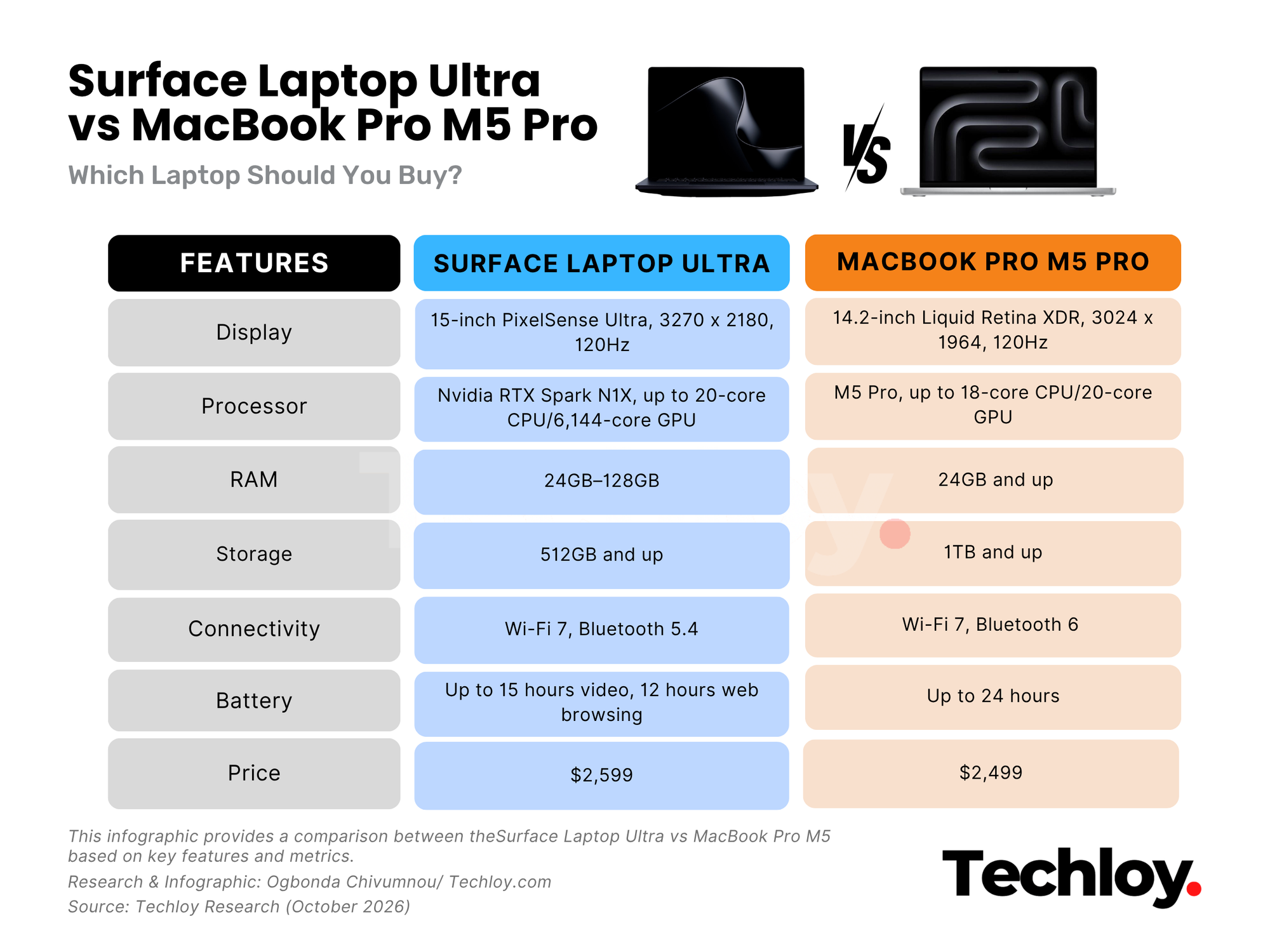
Apple’s 14-inch MacBook Pro with the M5 Pro chip sits in the same price range, starting at $2,499 compared with $2,599 for Microsoft’s laptop. The two machines are built around very different ideas of what a high-end laptop should be, which makes this comparison more interesting than a simple specs battle.
We have not had enough hands-on time with the Surface Laptop Ultra to declare a winner yet. But the hardware and design choices already tell us a lot about where Microsoft is taking the Surface lineup.
 Ogbonda Chivumnovu
/1. Price
The Surface Laptop Ultra starts at $2,599, putting it firmly in MacBook Pro territory. At that price, Microsoft gives you the RTX Spark N1X with a 5,120-core GPU and 18-core CPU, 24GB of memory, and a 512GB SSD.
The 14-inch MacBook Pro M5 Pro starts at $2,499, which is $100 cheaper. It also comes with 24GB of unified memory and a 1TB SSD. That last part matters. Microsoft gives you half the storage at a higher starting price.
The 16-inch MacBook Pro starts at $2,999, although Apple's laptop can become significantly more expensive if you move up to the M5 Max, more memory, and additional storage. Microsoft has a similar strategy. The Surface Laptop Ultra can reach $5,899 with 128GB of RAM and a 1TB SSD.
/2. Design
Microsoft clearly knows what a premium laptop should feel like. The Surface Laptop Ultra measures 12.9 x 9.4 x 0.7 inches and weighs 4.4 pounds. It has a large touchpad, a premium keyboard, and a design that looks remarkably familiar if you’ve used a MacBook Pro before.
The 15-inch display also gives Microsoft an interesting middle ground. It is larger than the 14-inch MacBook Pro without being as large as Apple's 16-inch model. Microsoft has also introduced a magnetic USB-C charging connection. It serves a similar purpose to Apple's MagSafe system, allowing the cable to detach if someone accidentally pulls on it.
The 14-inch MacBook Pro is smaller and considerably lighter at 3.4 pounds. The 16-inch model, meanwhile, weighs 4.7 pounds, making it slightly heavier than the Surface.
/3. Display
Microsoft's 15-inch PixelSense Ultra display is one of the Surface Laptop Ultra's biggest attractions. It has a 3270 x 2180 resolution and a 120Hz refresh rate, giving it a high-resolution, smooth display that's well suited to creative work and general productivity.
Apple's Liquid Retina XDR displays are also 120Hz, with the 14-inch model offering a 3024 x 1964 resolution and the 16-inch version reaching 3456 x 2234.
For professional creative work, Apple's display technology remains one of MacBook Pro's strongest selling points.
/4. Performance and local AI
This is where Microsoft's laptop becomes genuinely interesting. The Surface Laptop Ultra isn't primarily trying to beat the MacBook Pro at everyday computing. Microsoft is targeting people who want to run increasingly powerful AI models locally.
The RTX Spark N1X can be configured with up to a 20-core CPU, 6,144 GPU cores, and 128GB of unified memory. Microsoft says the system can deliver up to 1 petaflop of AI performance and run AI models with more than 120 billion parameters locally.
That's a major selling point for AI developers and other professionals working with local models.
Instead of sending every task to the cloud, users can potentially run larger models directly on the machine. That could mean lower latency, greater privacy, and less dependence on an internet connection.
The MacBook Pro M5 Pro is no slouch here. Apple's unified memory architecture has made MacBooks popular among developers who run local LLMs, and Apple Silicon is capable of handling demanding workloads.
But the Surface Laptop Ultra has been designed specifically around this emerging use case.
/5. Gaming
Subscribe for free to continue reading this article
Subscribe SubscribeAlready have an account? Log in


